Financial literacy is not merely a set of skills; it’s a critical life toolkit that empowers individuals to navigate the complex world of personal finance with confidence and competence. At its core, financial literacy encompasses the understanding and effective application of various financial skills, including but not limited to personal financial management, budgeting, and investing. This foundational knowledge is pivotal in making informed financial decisions, achieving financial stability, and circumventing the common financial pitfalls that many individuals face in their lifetime.
The significance of financial literacy extends beyond individual well-being; it plays a crucial role in promoting a healthier economy. By equipping individuals with the knowledge to manage their finances wisely, financial literacy fosters a society of informed consumers and investors, which in turn supports sustainable economic growth and stability. This article aims to shed light on the multifaceted benefits of financial literacy, offering insights into effective strategies for enhancing one’s financial knowledge across different demographics and underscoring the indispensable role of financial education in today’s society.
The Fundamentals of Financial Literacy
What is Financial Literacy?
Financial literacy is the foundation upon which sound financial decisions are built. It involves a comprehensive understanding of key financial concepts such as credit management, debt management, savings, investments, and the nuances of personal financial planning. This knowledge enables individuals to set and achieve their financial goals, whether it’s securing a comfortable retirement, buying a home, funding education, or simply managing daily expenses more effectively. Financial literacy is not just about accumulating wealth; it’s about fostering financial well-being and security, empowering individuals to make choices that align with their values and life goals.
The Impact of Financial Literacy on Personal Finance
The ripple effects of financial literacy on personal finance are profound and far-reaching. At its most basic, financial literacy enhances an individual’s ability to budget effectively, ensuring that expenses do not exceed income and that savings are a consistent priority. This discipline is the bedrock of financial stability, providing a buffer against unexpected financial shocks and stresses. Beyond budgeting, financial literacy also encompasses savvy debt management, enabling individuals to understand the true cost of credit and to use debt strategically rather than letting it accumulate uncontrollably.
Moreover, financial literacy opens the door to informed investing, demystifying the world of stocks, bonds, mutual funds, and other investment vehicles. This knowledge not only helps individuals grow their wealth but also protects them from the pitfalls of high-risk investments or scams. In essence, financial literacy equips individuals with the tools to build a secure financial future, fostering a sense of empowerment and freedom that transcends monetary value.
Enhancing Your Financial Literacy
Starting with the Basics
Embarking on the journey toward financial literacy begins with mastering the fundamentals. For individuals taking their first steps, it’s crucial to start with understanding basic financial concepts such as budgeting, saving, the importance of an emergency fund, and the basics of credit and debt management. Resources for learning are plentiful and accessible to everyone with an internet connection. Websites offering free financial education, such as the National Endowment for Financial Education (NEFE) or Khan Academy, provide a wealth of knowledge on these topics. Additionally, personal finance books by authors like Robert Kiyosaki and Dave Ramsey can offer insights into managing your finances effectively. Key concepts to grasp include the difference between needs and wants, the power of compounding interest, and the importance of living within your means. These foundational ideas set the stage for more advanced financial planning and decision-making.
Building Advanced Financial Knowledge
For those who have grasped the basics and are ready to delve deeper, advancing your financial knowledge involves exploring more complex areas such as investment strategies, tax planning, and retirement savings. This stage might include learning about the stock market, different types of investment accounts (like IRAs and 401(k)s), and understanding how to diversify your investment portfolio. Financial podcasts, webinars, and workshops can be invaluable resources, offering insights from experts and providing a platform for asking questions and engaging with complex topics. Additionally, consulting with a financial advisor can provide personalized advice tailored to your financial situation and goals. Key areas to focus on include understanding asset allocation, the impact of taxes on investments, and strategies for tax-efficient investing and estate planning. By building a comprehensive financial knowledge base, individuals can make more informed decisions that align with their long-term financial objectives.
Empowering Through Financial Literacy: A Visual Journey
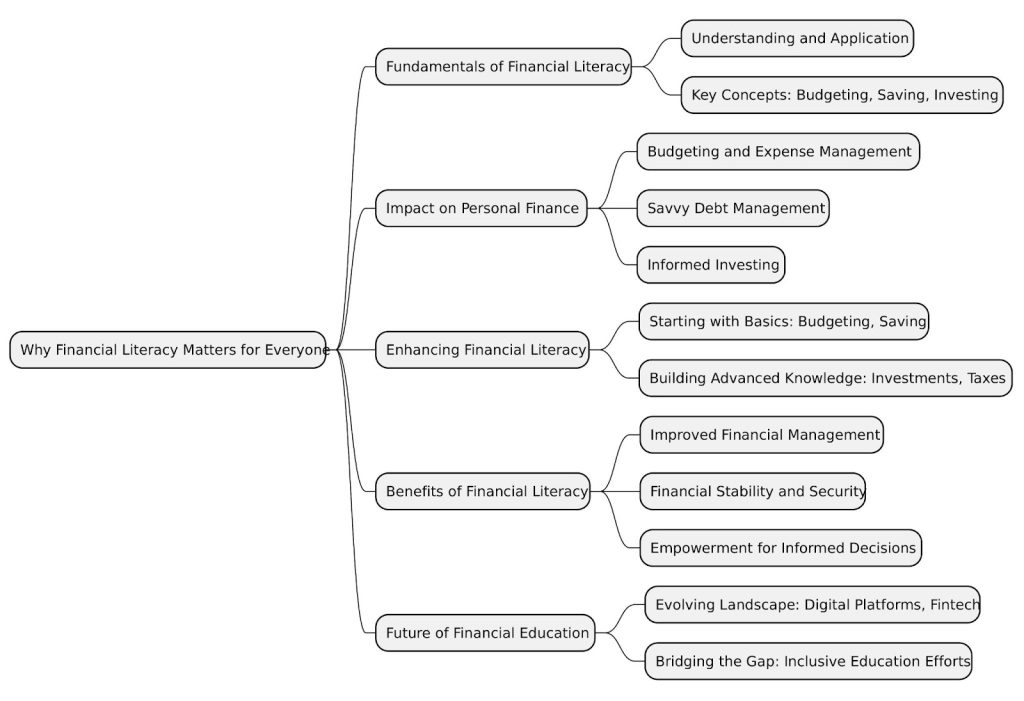
In the dynamic landscape of today’s economic environment, the imperative for financial literacy has transcended traditional boundaries, emerging as a universal necessity. The “Financial Empowerment Map” serves as a visual testament to this critical journey, encapsulating the multifaceted dimensions of financial literacy and its profound impact on individual empowerment and collective economic health.
This meticulously crafted diagram delineates the foundational pillars of financial literacy, starting with the core competencies of budgeting, saving, and investing. It underscores the transformative potential of these skills in fostering financial stability, enabling individuals to navigate the complexities of personal finance with acumen and confidence.
As the journey unfolds, the Mindmap highlights the pivotal role of advanced financial knowledge in achieving long-term prosperity. It illustrates how a deeper understanding of investment strategies and financial planning can unlock opportunities for wealth creation, offering a pathway to financial independence and resilience.
Beyond personal finance, the diagram ventures into the broader implications of financial literacy, showcasing its significance in bolstering economic growth and fostering a financially literate society. It emphasizes the collective benefits of widespread financial education, including enhanced economic stability and the empowerment of individuals to contribute meaningfully to the economy.
Incorporating the “Financial Empowerment Map” into the narrative not only enriches the discourse on financial literacy but also provides a structured framework for understanding its comprehensive benefits. It visualizes the journey from basic financial understanding to the apex of financial empowerment, offering a blueprint for individuals and educators alike to champion financial literacy as a catalyst for personal and societal advancement. Through this visual and narrative integration, the article invites readers to embark on their own journey toward financial literacy, equipped with the insights and inspiration to navigate the financial challenges of the 21st century.
Top 5 Benefits of Financial Literacy
1. Improved Personal Financial Management
Financial literacy equips individuals with the skills necessary for effective personal financial management. Knowledge of budgeting, saving, and investing empowers people to create and stick to a budget, set and achieve savings goals, and make informed investment choices. This proactive approach to managing finances ensures that individuals can maximize their financial resources, make their money work for them, and achieve a higher standard of financial well-being.
2. Increased Financial Stability and Security
A solid understanding of financial principles contributes significantly to long-term financial stability and security. Financially literate individuals are better prepared to build a robust financial safety net, including an emergency fund that can cover unexpected expenses without resorting to high-interest debt. Furthermore, knowledge of retirement planning ensures that individuals are setting aside sufficient funds for their future, contributing to a sense of security in their later years.
3. Reduced Risk of Falling into Debt
Financial literacy provides the tools to manage credit wisely and avoid the pitfalls of excessive debt. Understanding the cost of credit, interest rates, and the consequences of carrying a balance on credit cards can deter individuals from making poor borrowing decisions. Financially literate individuals are more likely to use credit as a strategic tool, rather than a means to fund an unsustainable lifestyle.
4. Empowerment to Make Informed Financial Decisions
One of the most empowering outcomes of financial literacy is the confidence it instills in individuals to make informed financial decisions. With a solid understanding of financial products, markets, and investment options, individuals can navigate the financial landscape with confidence, making choices that align with their goals and risk tolerance.
5. Contribution to Economic Health
On a broader scale, widespread financial literacy can contribute significantly to the overall health of the economy. An informed populace is less likely to engage in risky financial behaviors that can lead to economic instability. Furthermore, financially literate individuals are more likely to invest in the economy, whether through purchasing homes, investing in the stock market, or starting businesses, all of which stimulate economic growth and contribute to a more stable and prosperous society.
The journey to financial literacy is both empowering and essential for individuals aiming to achieve personal financial success and contribute to a healthier economy. By starting with the basics and progressively building advanced financial knowledge, individuals can enjoy the myriad benefits that financial literacy brings, from improved personal financial management to increased economic stability.
The Future of Financial Education
The Evolving Landscape of Financial Literacy
The landscape of financial literacy is undergoing a significant transformation, fueled by rapid technological advancements and shifts in global economic conditions. Digital platforms and online resources have democratized access to financial information, enabling individuals from all walks of life to enhance their financial knowledge. Fintech innovations, such as mobile banking apps, personal finance management tools, and online investment platforms, are reshaping how people interact with their finances, making it more crucial than ever to possess a solid understanding of financial principles. Furthermore, the global economy’s complexities necessitate a deeper comprehension of international finance, investment diversification, and risk management. As we move forward, financial education must adapt to these changes, incorporating digital literacy and global financial awareness to equip individuals for the challenges and opportunities of the 21st century.
Bridging the Financial Literacy Gap
Despite these advancements, a significant gap remains in financial literacy across various demographics, underscoring the need for more inclusive financial education efforts. Disparities in financial knowledge and access to resources often fall along lines of socioeconomic status, age, and educational background, perpetuating a cycle of financial instability and inequality. Bridging this gap requires targeted initiatives that tailor financial education to the needs of underserved communities, leveraging technology to reach wider audiences and developing curricula that address the specific challenges faced by different groups. By fostering partnerships between educational institutions, non-profit organizations, and the financial industry, we can create comprehensive programs that not only impart essential financial skills but also inspire a culture of lifelong learning and financial empowerment.
FAQs on Financial Literacy
Why is financial literacy important at a young age?
Instilling financial literacy at a young age lays the foundation for responsible financial behavior and decision-making in adulthood. Early education in budgeting, saving, and investing helps young people develop habits that lead to financial stability and success, empowering them to achieve their long-term goals and avoid common financial pitfalls.
How can schools and communities promote financial literacy?
Schools and communities can promote financial literacy by integrating financial education into the curriculum, offering workshops and seminars, and partnering with financial institutions to provide practical learning opportunities. Financial literacy programs should be made accessible to all age groups, with content tailored to the developmental stages and interests of the learners.
What are some common misconceptions about financial literacy?
Common misconceptions about financial literacy include the belief that it is only relevant for adults, that it requires complex mathematical skills, and that it is only about saving money. Financial literacy is a broad discipline that applies to individuals of all ages, emphasizes critical thinking over complex math, and covers a wide range of topics from budgeting to investing and risk management.
How does financial literacy differ across cultures and economies?
Financial literacy can vary significantly across cultures and economies due to differences in financial systems, societal values regarding money, and access to financial education and resources. These variations highlight the importance of culturally sensitive and contextually relevant financial education that respects and addresses the unique financial landscapes and challenges faced by different communities.
In Conclusion
Financial literacy is an indispensable tool for navigating the complexities of the modern financial landscape, offering profound benefits for personal well-being and the broader economy. From improving personal financial management to contributing to economic stability, the advantages of financial literacy are vast and varied. As we look to the future, the evolution of financial education will play a pivotal role in bridging the literacy gap and ensuring that individuals of all demographics have access to the knowledge and skills necessary for financial success. The integration of financial literacy into education systems and the pursuit of inclusive, adaptive learning initiatives represent crucial steps toward a future where everyone is equipped to achieve financial security and independence.

Jeffrey Hammel is a chief financial officer in corporate finance with an MBA from Indiana University’s Kelley School of Business. He partners with boards and leadership teams on risk management, M&A integration, business planning, and growth—and is known for building trust-based, high-performance cultures.