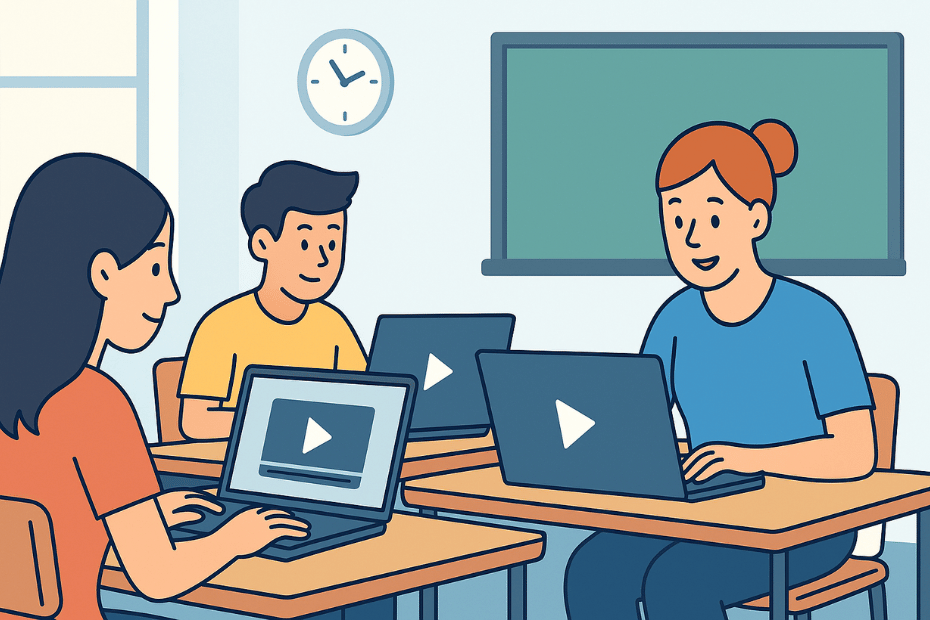
If you’re looking for a way to make education more engaging, effective, and accessible, visual learning through videos is one of the most practical solutions available. Whether you’re teaching students in a classroom, training employees, or building your own knowledge, video-based instruction helps clarify ideas, boost retention, and meet learners where they are. In this article, you’ll learn how video enhances understanding, supports memory, bridges accessibility gaps, and transforms traditional instruction into a more interactive and inclusive experience.
Videos Hold Attention Longer and Support Comprehension
Attention is a limited resource in learning environments, and videos are one of the most effective tools for maintaining it. When you combine visuals, motion, and sound, learners are more likely to stay focused. This is especially helpful for younger students or adults with limited attention spans. You’re not just presenting information—you’re activating multiple senses at once, which helps concepts click faster.
The real benefit comes when videos use real-life demonstrations, animations, or simple visual storytelling. They help explain abstract ideas—like electricity, supply chains, or sentence structure—in ways that feel intuitive. When learners can see how something works, the gap between theory and understanding shrinks. Even complex ideas become digestible when you package them into short, well-paced visual segments.
Visual Content Improves Recall and Long-Term Retention
Memory depends on connection—and videos build those connections through imagery and structure. If you’ve ever remembered how to fix something because you saw it done in a video, you’ve experienced this effect. The brain retains visual cues more effectively than text alone. When paired with narrative or audio, that retention rate increases.
In subjects like science, math, and technical training, this is especially valuable. Watching a chemical reaction or a machine assembly process creates a mental image that’s easier to recall than reading about the same process in a manual. When you give learners multiple reference points—motion, sound, narration—you support deeper learning that lasts longer.
Videos Offer the Flexibility That Modern Learners Need
One major reason video works is that it adapts to the learner—not the other way around. You can pause, rewind, and replay at your own pace. Whether someone needs to revisit a difficult section or skip ahead to more relevant material, video-based learning meets that need without slowing down the rest of the class.
This flexibility is crucial in mixed-ability classrooms, remote learning environments, and professional training settings. Everyone learns at a different speed, and video supports that range better than most static materials. It also allows for flipped classrooms, where learners absorb content outside class time and use in-person sessions for discussion or practice.
Visual Media Makes Learning More Accessible and Inclusive
Visual learning opens the door to more people. For those with reading difficulties, limited literacy, or different language backgrounds, videos can provide alternative ways to understand material. Subtitles, translations, and sign language options increase accessibility for a broader audience.
Students with learning disabilities, like dyslexia or ADHD, often benefit from visual instruction because it reduces reliance on written content and adds structure. And for learners who are more visually or auditorily inclined, videos give them a mode of learning that feels natural and less frustrating. When you build lessons around visual media, you’re not just enriching your content—you’re removing barriers that prevent understanding.
Real-World Applications Make Lessons Stick
One of the most effective uses of video in education is to show real-world relevance. You can explain the Pythagorean theorem with a formula—or you can show how it’s used in construction or architecture. Seeing the concept applied outside of a textbook helps learners understand its importance and makes them more likely to remember it.
This kind of contextual learning is motivating. It answers the common question, “When will I ever use this?” by providing a concrete answer. Whether you’re teaching business strategy, health sciences, or auto repair, a good video makes the leap from theory to application feel immediate and achievable.
Interactivity Turns Passive Watching into Active Learning
Watching isn’t enough. To get real results, you need learners to engage with the content—and interactive video makes that possible. Embedded quizzes, prompts, or scenario-based questions can turn a video lesson into an active experience. This helps reinforce learning in real time and increases retention.
Interactive elements also allow you to assess understanding without disrupting the flow of instruction. You can spot gaps in comprehension and address them early. In training environments, this leads to fewer mistakes down the line. In academic settings, it creates more independent learners who are responsible for their own progress.
You Can Support Every Learning Style in One Format
Different people learn in different ways—some absorb ideas best by reading, others by listening, and some by seeing or doing. Video content blends all these elements into a single medium. With careful planning, you can create learning experiences that appeal to visual, auditory, and kinesthetic learners alike.
A science video might show a process (visual), explain it out loud (auditory), and prompt viewers to try it with hands-on materials (kinesthetic). This combination increases the chances that the lesson sticks for everyone. And since many platforms support transcripts, closed captions, and interactive timelines, learners can engage in the way that suits them best.
Top Benefits of Visual Learning Through Videos
- Boosts attention and comprehension
- Improves memory and long-term retention
- Supports flexible and self-paced learning
- Increases accessibility for diverse learners
- Connects theory to real-world practice
- Encourages interactive, active learning
- Accommodates multiple learning styles
In Conclusion
Video has changed the way people learn. It breaks down difficult material, keeps attention longer, and gives learners more control over how they engage with new information. Whether you’re teaching students, training staff, or learning something yourself, visual content makes that process more effective and inclusive. You’re not just watching a screen—you’re building skills, solving problems, and connecting ideas in a way that sticks. And with better access to tools and platforms than ever, there’s no reason not to make videos part of your teaching strategy.
For more on innovative education strategies, digital learning tools, and insights into visual instruction, connect with my LinkedIn.

Jeffrey Hammel is a chief financial officer in corporate finance with an MBA from Indiana University’s Kelley School of Business. He partners with boards and leadership teams on risk management, M&A integration, business planning, and growth—and is known for building trust-based, high-performance cultures.