
The EdTech industry has seen exponential growth, driven by the digital revolution and the global push for accessible education. This surge is not just a testament to innovation but also to strategic maneuvers like mergers and acquisitions (M&As), which have become increasingly prevalent. These M&As are not mere financial transactions but pivotal moments that amalgamate diverse technologies, philosophies, and markets within the EdTech space. They aim to enhance the delivery and effectiveness of education, showcasing the sector’s commitment to evolving and meeting the diverse needs of learners worldwide.
Historical Context of M&As in EdTech
The last decade has marked a significant era for M&As in the EdTech sector, characterized by notable deals that have driven both consolidation and expansion across the industry. This period witnessed strategic acquisitions by larger entities seeking to diversify their digital offerings and incorporate innovative technologies such as adaptive learning and AI-driven analytics into their portfolios. These transactions have been instrumental in reshaping the competitive landscape, allowing established companies to solidify their market presence while enabling startups to scale their impactful solutions. The history of M&As in EdTech reflects a strategic response to the burgeoning demand for integrated, technology-enabled educational experiences, setting a precedent for the sector’s growth trajectory.
Strategic Benefits of M&As in EdTech
Synergy and Innovation
M&As in the EdTech sector catalyze the fusion of complementary technologies, creating a hotbed for innovation. This synergy not only enhances the product offerings of the combined entities but also opens up new avenues for addressing educational challenges. By pooling resources and expertise, merged companies can expedite the development of breakthrough solutions, from personalized learning environments to comprehensive management systems, thereby pushing the boundaries of what’s possible in education technology.
Market Expansion
M&As serve as a strategic pathway for EdTech companies to broaden their market reach and penetrate new segments. By acquiring companies with established local presences or niche expertise, businesses can swiftly enter new markets, bypassing the barriers that typically hinder market entry. This aspect of M&As is crucial for realizing the global mission of education, ensuring that innovative educational solutions can transcend geographical and cultural barriers to benefit learners worldwide.
Scaling Solutions
The ability to scale solutions effectively is a critical advantage of M&As in the EdTech space. Educational needs are vast, varied, and often fragmented, posing a challenge for companies aiming to make a significant impact. Through strategic mergers, EdTech companies can leverage combined technologies, distribution networks, and expertise to scale their solutions more efficiently, thereby reaching a wider audience and making a more substantial impact on global education.
M&As play a vital role in the evolution of the EdTech industry, fostering synergy, enabling market expansion, and facilitating the scaling of innovative solutions. These strategic moves are instrumental in navigating the complexities of the educational landscape, ensuring that technology’s potential to transform education is fully realized.
Challenges and Considerations in EdTech M&As
Cultural and Operational Integration
One of the most significant challenges facing EdTech companies during M&As is the integration of disparate company cultures and operational systems. Merging entities often find that aligning organizational values, work styles, and communication patterns requires more than strategic intent; it necessitates careful planning and sensitivity. Furthermore, operational systems such as IT infrastructure, product development cycles, and customer service protocols can vary widely between companies. Successfully integrating these aspects is crucial to realizing the full potential of a merger, requiring a thoughtful approach that respects the strengths and uniqueness of each entity while striving for a cohesive new operation.
Regulatory Hurdles
The education sector is subject to a complex web of regulations that can vary significantly by region and educational level. EdTech companies engaging in M&As must navigate these regulatory landscapes, ensuring compliance across different jurisdictions. This challenge is compounded when mergers involve companies operating in multiple countries or educational systems, requiring a deep understanding of legal requirements and often, strategic adjustments to business models to maintain compliance while pursuing growth objectives.
Maintaining Educational Integrity
Amidst the pursuit of growth and expansion through M&As, EdTech companies must remain steadfast in their commitment to educational integrity. The quality of educational offerings should not be compromised for the sake of expansion. This requires a balanced approach to scaling, ensuring that educational content, pedagogical approaches, and learner outcomes are preserved and enhanced. Companies must continue to prioritize the educational mission at the heart of their operations, ensuring that growth strategies align with the goal of delivering impactful, quality education.
Navigating Change: The Strategic Role of M&As in EdTech Evolution
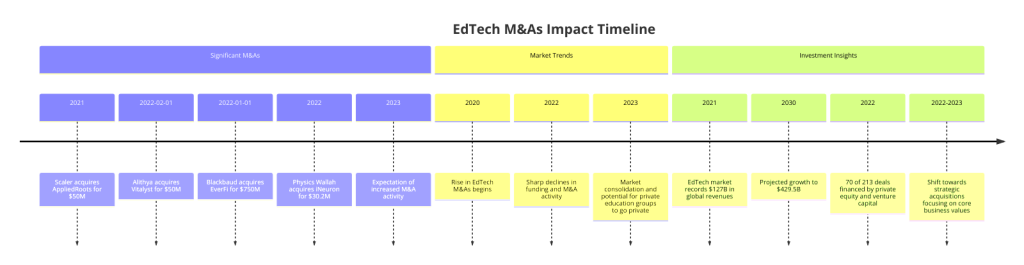
In the dynamic landscape of education technology (EdTech), strategic mergers and acquisitions (M&As) have emerged as crucial levers for growth and innovation. The timeline above captures significant transactions and market trends that have shaped the EdTech sector’s trajectory over recent years. Starting from 2020, the increase in M&A activity marked the sector’s response to the burgeoning demand for digital learning solutions. Key deals, such as Blackbaud’s acquisition of EverFi for $750M and Physics Wallah’s purchase of iNeuron for $30.2M, underscore the strategic intent behind these transactions—to enhance capabilities, expand reach, and drive technological integration.
Despite a cooldown in 2022, with notable drops in funding and M&A activity, the anticipation for 2023 points towards a resurgence, with an expectation of increased M&A activity. This pivot is likely to steer the market towards further consolidation, potentially leading more private education groups to go private. The timeline also highlights the projected growth of the EdTech market from $127B in global revenues in 2021 to an expected $429.5B by 2030, emphasizing the sector’s pivotal role in the future of education.
The Future of M&As in EdTech
The landscape of mergers and acquisitions within the EdTech sector is poised for significant evolution, driven by rapid advancements in technology and shifting educational paradigms. Emerging trends suggest a future where M&As increasingly focus on harnessing cutting-edge technologies such as artificial intelligence (AI), machine learning, and blockchain to create more personalized, efficient, and secure learning environments. As educational institutions and learners seek more adaptive and engaging ways to learn, companies that offer innovative solutions in these areas are likely to become attractive targets for M&As.
The potential impact of future M&As on learning outcomes and accessibility is profound. By combining resources and expertise, companies can develop solutions that significantly enhance the quality of education and make it more accessible to diverse populations. For instance, M&As that bring together AI-driven personalized learning platforms with wide-reaching educational content providers have the potential to democratize access to tailored educational experiences, breaking down barriers related to location, economic status, and learning abilities.
Furthermore, the role of startups and innovation within the M&A strategy is crucial. Startups often represent the forefront of innovation in EdTech, bringing fresh ideas and technologies to the table. Nurturing these companies and incorporating them into larger entities through strategic M&As can inject vitality into the educational sector, ensuring a continuous pipeline of new solutions to meet the evolving needs of learners and educators alike. As such, fostering an ecosystem that supports startups and encourages their growth through acquisitions or partnerships will be key to sustaining innovation in EdTech.
In conclusion, Mergers and Acquisitions have undeniably played a pivotal role in shaping the EdTech industry, driving its growth, innovation, and the expansion of educational access. Through strategic consolidation and the integration of complementary technologies and capabilities, M&As have facilitated significant advancements in how education is delivered and experienced. As the sector continues to evolve, the strategic use of M&As will remain a vital tool for companies seeking to navigate the complexities of the global educational landscape.
Looking ahead, stakeholders across the EdTech ecosystem — from entrepreneurs and investors to educators and policymakers — are encouraged to embrace strategic M&As as a mechanism for fostering growth, catalyzing innovation, and enhancing educational accessibility. By doing so, the EdTech industry can continue to adapt to changing technological and educational needs, ensuring that it remains at the forefront of delivering impactful learning experiences. The future of education is one that is increasingly digital, personalized, and accessible, and M&As will be key to realizing this vision, transforming learning for the better on a global scale.

Jeffrey Hammel is a chief financial officer in corporate finance with an MBA from Indiana University’s Kelley School of Business. He partners with boards and leadership teams on risk management, M&A integration, business planning, and growth—and is known for building trust-based, high-performance cultures.