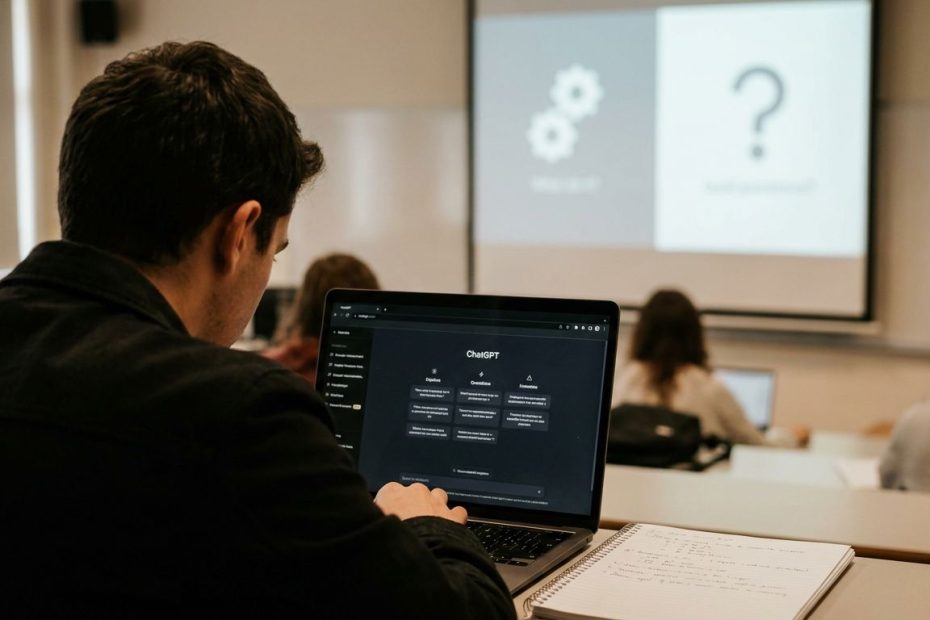
ChatGPT in class is neither a simple ally nor a simple threat. It helps you learn faster when you use it for feedback, clarification, and practice, but it weakens learning and trust when you use it to replace your own thinking.
If you want a useful answer to this debate, you need more than hot takes. You need evidence on learning outcomes, cheating risks, teacher use, weak detection tools, and the policies that actually work when artificial intelligence enters real classrooms. This article gives you that, so you can judge where ChatGPT supports education and where it starts to damage it.
Can ChatGPT Improve Student Learning Outcomes?
Yes, it can. Recent meta-analyses on ChatGPT and student learning show that students often gain small to moderate benefits when the tool is used with structure, especially for feedback, guided practice, brainstorming, and explanation support. That matters because it moves the conversation away from slogans and toward a more useful standard: you should judge ChatGPT by how it is used, not by what it is called.
In practical classroom terms, ChatGPT works best when it acts like a support layer rather than a substitute for thinking. If you use it to clarify a reading, generate practice questions, explain a difficult concept in simpler language, or help organize an outline, you can reduce friction and stay engaged with the work. If you hand the cognitive load to the system and submit polished output you did not build, the benefit drops fast because the performance may rise while the learning does not.
The strongest reading of the current research is not that ChatGPT magically improves education. It is that guided use can improve parts of the learning process. You still need teacher direction, assignment design, and some friction that forces you to recall, explain, revise, and defend what you know. Without those pieces, convenience starts to crowd out mastery.
This is why educators who understand instruction design are paying attention to scaffolding. When your teacher gives you a prompt structure, asks for reasoning steps, requires revision notes, or uses ChatGPT as a critique partner instead of a ghostwriter, the tool can strengthen your work habits. The technology is useful, but the learning gains come from the structure wrapped around it.
Is ChatGPT Making Students Smarter Or Just More Dependent?
That depends on whether you use it to extend your effort or avoid it. A student who uses ChatGPT to test understanding, compare interpretations, or check whether a draft is clear is building academic control. A student who uses it to produce whole assignments with minimal involvement is building dependence, even if the grade looks fine on paper.
You can already see this divide in classrooms. Some students use generative artificial intelligence to reduce confusion and move past blank-page paralysis. Others use it to dodge reading, compress writing time, and hide weak preparation behind polished sentences. The output can look similar, but the learning underneath is very different.
Dependency usually shows up in predictable ways. You lose your own writing voice, your class discussion performance weakens, and your ability to explain what you submitted becomes shaky. That matters more than any detector score because real learning leaves evidence in how you talk, revise, connect ideas, and answer follow-up questions.
If you want ChatGPT to stay an ally, you need to keep authorship in your hands. Use it after you think, not before. Draft your own answer first, test your reasoning against the tool, and make sure you can defend every claim without looking at a screen. That one habit separates assisted learning from outsourced thinking.
Is ChatGPT Mostly A Cheating Tool In School?
No, but it can become one very quickly when classroom rules are vague. Current higher education survey data shows frequent student use of artificial intelligence for schoolwork, yet many students also report unclear guidance or mixed messages from instructors and institutions. When rules are fuzzy, students fill the gap with their own assumptions, and those assumptions often drift toward convenience.
This is where the ally-versus-threat debate gets real. ChatGPT is not only used for cheating. Students use it for tutoring, editing, summarizing, brainstorming, study support, and language help. At the same time, many instructors report a rise in AI-assisted submissions that appear polished but thin, generic, or disconnected from actual class activity.
You should pay attention to the gray zone. A lot of misuse does not begin with blatant fraud. It starts with a student asking for “just a little help,” then accepting a paragraph, then a page, then a full draft. Once that line shifts, authorship becomes murky, and the student often rationalizes the choice because the policy never felt concrete to begin with.
Schools that handle this well do not rely on broad warnings alone. They define allowed use, forbidden use, disclosure expectations, and proof of process. When your instructor says you may use ChatGPT for outlining but not for drafting, or for feedback but not for final wording, you know where the line is. That level of precision reduces conflict and gives honest students a fairer environment.
Do AI Detectors Reliably Catch ChatGPT Use?
No, and that is one of the biggest reasons the debate is so tense. Artificial intelligence writing detectors have not proven reliable enough to serve as sole evidence against a student. OpenAI withdrew its own artificial intelligence text classifier due to low accuracy, and reporting around Turnitin’s detector raised concerns about false positives and overconfidence.
If you are a student, this should matter to you for two reasons. If you misuse ChatGPT, you should not assume weak detection makes that safe. Teachers can still identify suspicious work through process gaps, sudden style shifts, shallow explanations, missing drafts, and poor oral follow-through. If you do honest work, you should also know that detector scores alone are not a trustworthy basis for accusation.
The better schools are moving toward evidence of authorship rather than automated suspicion. That means revision history, rough drafts, in-class writing samples, short oral checks, source notes, personalized prompts, and reflective explanations of how the final answer was built. Those methods are less flashy than detection dashboards, but they are more defensible and far more useful for teaching.
When people frame the issue as a policing problem, they miss the bigger point. Detection tools do not solve weak assessment design. If an assignment can be completed well by a chatbot with no student thinking visible, the assignment itself needs work. Stronger assessment design protects integrity better than software promises do.
Are Teachers Using ChatGPT Too?
Yes, and at this point that is not a side note. Teacher use of artificial intelligence is already mainstream enough to shape classroom norms. Gallup reporting shows that a large share of kindergarten through twelfth grade teachers have used artificial intelligence tools for their work, which means ChatGPT is not just entering through students. It is already part of the adult workflow in education.
That creates a trust problem when schools ban student use without explaining why teacher use is allowed. Students notice the contradiction fast. If a teacher uses artificial intelligence to create lesson materials, draft rubrics, or streamline feedback but treats any student use as dishonesty, the classroom can feel less like a place of standards and more like a place of unequal rules.
The answer is not to forbid teachers from using useful tools. The answer is transparency and matching standards to purpose. If a teacher uses ChatGPT for administrative efficiency or idea generation, that should be stated plainly. If students may use it for brainstorming, grammar feedback, or study support but not for final authored responses, that should be stated just as plainly.
Trust improves when expectations are symmetrical. You do not need identical rules for teachers and students because the tasks are different. You do need consistent logic. The strongest classrooms explain why some uses support learning and why other uses interfere with it. Once that logic is visible, the rules feel less arbitrary and more credible.
Does ChatGPT Threaten Essays, Short Answers, And Take-Home Assignments?
Yes, especially when those tasks rely on generic prompts and unsupervised text production. Research in medical education showed that ChatGPT could produce short-answer responses that performed above a minimum-passing student group on some assessment tasks. That should get your attention because it shows the tool can meet at least part of the performance bar in settings once assumed to reflect student knowledge alone.
When you apply that to ordinary classroom writing, the problem becomes obvious. If a take-home essay asks broad questions that can be answered with public knowledge and standard structure, ChatGPT can generate something usable within seconds. The assignment may still look rigorous from the outside, but its ability to measure your own thinking has weakened.
That does not mean essays are dead. It means generic essays are in trouble. To preserve value, instructors need prompts that demand class-specific evidence, local discussion points, unique data, version tracking, oral defense, or process reflection. You need tasks where your own choices are visible and where generic artificial intelligence output is easy to spot because it lacks the lived details of the course.
You can think of this as a shift from product-only grading to process-plus-product grading. That is a healthy move even without artificial intelligence. Students learn more when they are assessed on idea development, revision quality, source use, and explanation of choices, not only on a polished final page. ChatGPT did not create that truth, but it has forced schools to confront it.
What Are The Best Student Uses Of ChatGPT In Class?
The strongest student uses are the ones that increase your understanding without taking ownership away from you. That includes asking for concept explanations, getting feedback on structure, generating practice quizzes, checking whether your argument makes sense, identifying gaps in a draft, and turning confusing instructions into simpler language. These uses support your effort instead of replacing it.
Language support is another important area. If you are writing in a second language, managing reading load, or trying to tighten grammar after you already built the argument, ChatGPT can reduce friction that has nothing to do with your actual grasp of the material. Used carefully, it can help you express what you know more clearly. That is a meaningful educational benefit, not a shortcut.
Brainstorming also fits the ally category when you remain the decision-maker. You can ask for possible thesis angles, counterarguments, research questions, or practice problems, then choose what fits the assignment and discard the rest. That keeps your judgment active. The moment the system starts making the substantive decisions for you, the educational value starts to erode.
A good personal rule is simple: use ChatGPT for coaching, not substitution. If the tool helps you ask better questions, revise with more precision, or study with better focus, it is serving you well. If it lets you skip reading, skip drafting, or skip thinking, it is training the wrong habits.
What Should Schools And Instructors Do Instead Of Fighting A Losing Battle?
They should govern use with precision, redesign assessment, and teach responsible use directly. Major guidance from education organizations points toward managed adoption rather than blanket prohibition. That fits the reality on the ground, where student use is widespread, teacher use is rising, and detection tools do not offer a clean enforcement answer.
Good policy starts with clear categories. Allowed uses might include brainstorming, clarification, grammar review, study questions, and feedback. Restricted uses might include full-draft generation, hidden paraphrasing, fabricated citations, or submission of artificial intelligence output as personal work. Required disclosure should be simple enough that students can actually follow it without guessing.
Assessment design needs equal attention. Instructors should build more in-class writing, oral explanation, staged drafts, personal reflection, source annotations, and assignments tied to class-specific material. These shifts do more than discourage misuse. They create stronger evidence of learning, which is what education is supposed to value in the first place.
You also need direct instruction on how to use generative artificial intelligence well. Telling students “do not cheat” is not enough. Students need examples of acceptable prompts, examples of unacceptable outsourcing, and criteria for evaluating whether a use supports learning or strips it away. When schools teach those distinctions clearly, the classroom becomes less reactive and more disciplined.
So, Is ChatGPT In Class A Student’s Ally Or Threat?
It is an ally when it sharpens your understanding, improves your study process, and keeps your authorship intact. It becomes a threat when it masks weak effort, erodes trust, and makes your grade less connected to your actual ability. That is the honest answer, and it is more useful than any absolute position.
If you are a student, the right question is not whether ChatGPT is good or bad. The right question is whether your use of it produces real competence that still shows up when the screen is gone. If you cannot explain the answer, defend the argument, or reproduce the thinking in class, then the tool helped your submission more than it helped you.
If you are an educator, the issue is not whether artificial intelligence exists in school. It already does. The issue is whether your course design, policy language, and assessment methods reflect that reality with enough precision to preserve learning and fairness. The schools that do this well will not be the ones that shout the loudest. They will be the ones that define authorship, teach responsible use, and build assignments that reveal genuine understanding.
That is why the best verdict is conditional rather than ideological. ChatGPT is not the future of learning by itself, and it is not the end of learning either. In your classroom, it will become whatever your rules, habits, and assessment design allow it to become.
Is ChatGPT Good Or Bad For Students?
- Good when you use it for feedback, tutoring, practice, and clarification.
- Bad when you use it to replace reading, writing, or original thinking.
- Weak policies and weak assignments turn it into a bigger threat.
- Clear rules and process-based grading turn it into a useful support tool.
Use ChatGPT With Discipline, Not Dependence
You do not need to fear ChatGPT, and you should not hand your education over to it either. The evidence points in one direction: the tool helps when it supports learning tasks and hurts when it replaces them. If you keep authorship, explanation, and revision in your own hands, you can use artificial intelligence without weakening the skills school is supposed to build. If your school wants fairness, it needs clearer rules, stronger assignment design, and less faith in shaky detection tools. That is how ChatGPT stays a classroom ally instead of becoming an academic threat.

Jeffrey Hammel is a chief financial officer in corporate finance with an MBA from Indiana University’s Kelley School of Business. He partners with boards and leadership teams on risk management, M&A integration, business planning, and growth—and is known for building trust-based, high-performance cultures.